The usage of saddle pads.
How to choose?
Saddle pads are available in countless quantities and versions. When asked which material they prefer, experts quickly agree. The unanimous answer: natural sheepskin wool. Contrary to popular belief, sheepskin—if it is not a cheap imitation—is also the best in terms of heat dissipation. Horses with sheepskin do not sweat more than without it, and there are practically no heat pockets under it, as the skin distributes heat very well. Experts also prefer natural sheepskin for pressure absorption. It distributes pressure peaks very well. The pressure is not displaced, as is the case with other pads, but distributed and thus reduced.
It is important to choose sheepskin pads that are large enough. Often, pads that are too small are purchased. For pads with leather edges, these must never be located directly under the front and rear parts of the saddle panels, the edges of the saddle pad must lay outside of saddle panels! Otherwise his can cause painful pressure points. The width of the pad should also be chosen carefully. If the edges of the pad are directly under the ends of the saddle arches, this can cause pressure and discomfort for the horse. Make sure that the pad extends low enough along the horse's body.
Sheepskin saddle pads are also available with shorter hair in the spine area or even with cutouts in the spine channel. These models are designed to provide greater freedom of movement for the spine and even better ventilation. In addition, sheepskin saddle pads are available with pockets in which corrective inserts can be placed if the saddle is not fully adjusted. Natural materials such as felt inserts are most suitable as they have the least impact on the riding experience.
Another popular type of saddle pad is gel or silicone pads. They are available in both perforated, i.e., with ventilation holes, and closed versions. The material from which gel pads are made does not have the heat-regulating properties of sheepskin. Therefore, heat pockets can form under gel pads because heat cannot escape through the material. Heat combined with pressure can damage tissue very quickly. If you choose gel or silicone pads, be sure to choose the perforated option.
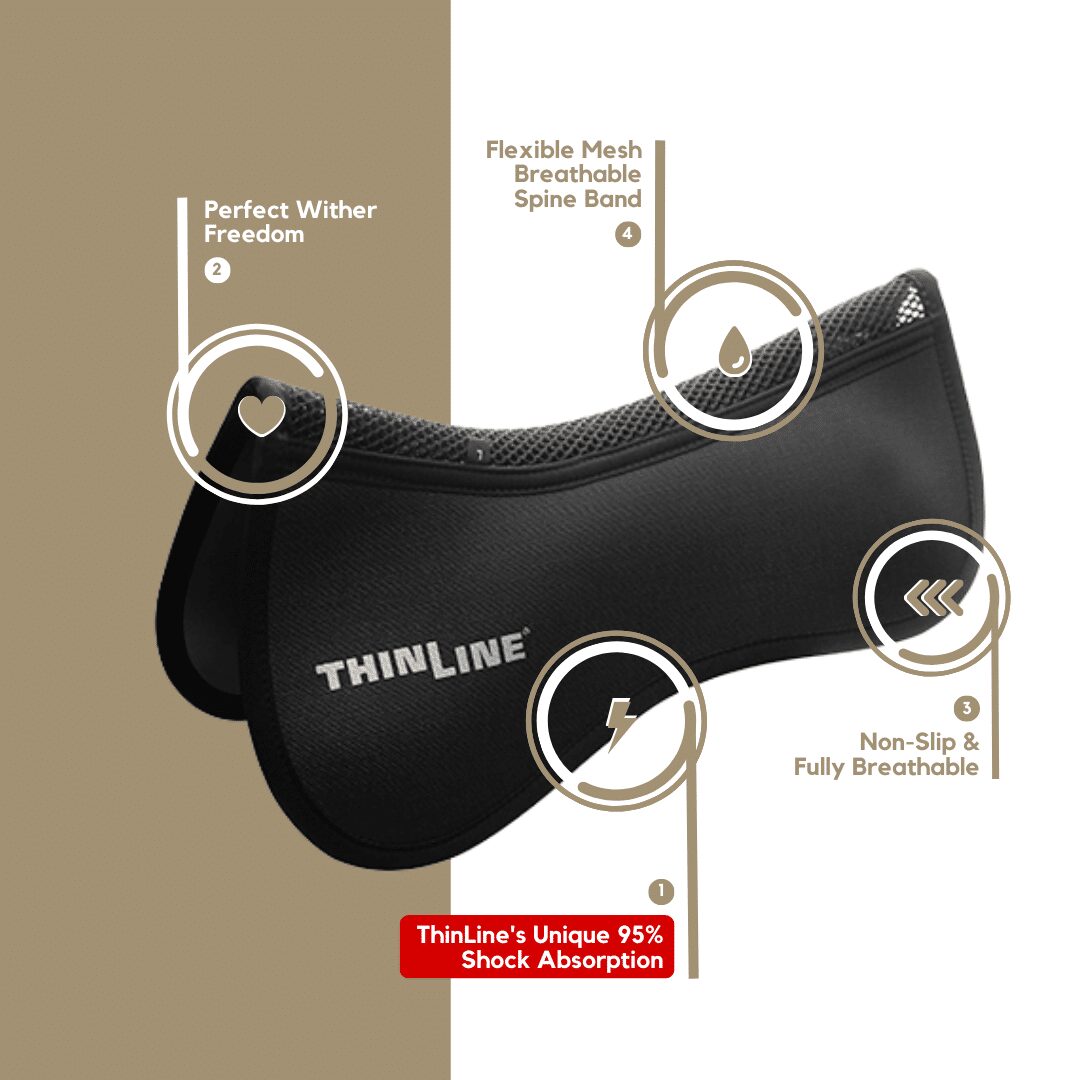
Of course, there are also saddle pads made of modern synthetic materials available on the market that provide good support, air circulation, and heat exchange. One such pad is the ThinLine saddle pad, manufactured in Belgium.
Some types of foam materials ( Tempur, Memory Foam ) take a long time to regain their original shape after compression. Therefore, such pads lose their effectiveness when subjected to high-frequency impacts, such as when a horse is galloping or jumping. Caution should also be exercised with pads that combine several materials. For example, there are gel pads with sheepskin edges or cotton pads with gel elements. Different materials react and behave differently. The dynamics of the saddle seat are difficult to assess if different materials are placed underneath it. If, for example, the pad is more flexible at the back than at the front, this can cause complications. Use such pads with caution.
What should you pay attention to?
The decision for or against a saddle pad should be made depending on the purpose for which you want to use it. If it is only a matter of pressure absorption and relief, a natural sheepskin saddle pad or a saddle pad that is sufficiently firm and allows air circulation is most recommended. However, if you want to change the saddle fit and balance, sheepskin or cotton saddle pads with pockets and removable inserts, as well as raised perforated gel or silicone pads, are suitable.
Please note that there are horses with unfavorable body type for which it is technically impossible to adjust the saddle so that it fits perfectly! In such cases, the use of corrective pads will be necessary.
For horses with pronounced, large withers, it is highly recommended to choose a saddle pad with a corresponding cut to avoid pressure points and chafing! The same applies to all types of saddle pads for these horses!
It is important that the saddle pad is sufficiently long and wide. If you feel that your horse is more comfortable with a saddle pad than without one, feel free to continue riding with it!
For horses that only walk, a neoprene saddle pad may be sufficient, but for faster and more powerful gaits, it will no longer be effective.
If you need to correct an unstable and poorly fitting saddle, be sure to consult with a saddle fitter and discuss possible saddle changes. There is a big difference in saddle fitting depending on whether the horse is ridden with only a saddle pad or with a saddle pad and adjustpad. Especially sheepskin saddle pads without a cutout for the spine narrow the saddle chamber, which must of course be taken into account when adjusting the saddle.
Overly soft materials are not recommended for either pads or saddles. Anything that is too soft makes the saddle less stable. The same applies to pads that are too thick. The tighter the saddle fits the horse, the more directly the rider can follow the horse's movements. Conversely, the more layers there are between the rider and the horse (e.g., saddle, sweat flap, and thick saddle pad), the easier it is for instability to occur. Therefore, when choosing the right saddle pad, the principle of "the simpler, the better" should be followed. If the saddle is not optimally fitted to the horse, you should first go to a saddle fitter before placing any pad under it!
Cart is empty.